What Design is being asked to create, and the rules it plays by
11 things to make · 4 to design and write · 7 copy only · 3 new, 8 change something live
Due at Gate 2; the date is set when the round is scoped. Two calls are Design’s at the design session: how one card holds eight endings without becoming two, and building from the live patterns. The screen itself, its endings, defects and Product’s approvals: the App experience page, at the end of the tab row.
The problem Losing reads as a dead end. The full framing and the evidence: the campaign brief.
The job to be done “Tell me where I stand in the auction in real time, and if I lose, give me a way forward rather than a dead end.”
What should losing feel like, so that coming back is the natural next step and never feels chased?
| # | The asset | New, or a change to something live | What we need from Design | Every version to write |
|---|---|---|---|---|
| 1 | Outbid alert PHASE 1 Its send is on the CRM brief. ▸ Today, live: the creative this reworksToday, live  The full record ↗ The full record ↗PUSH reaches them outside the app | CHANGE Rewording a push that already sends. | COPY ONLY Title and body. |
▸ The job, the copy and where it livesWhere the copy lives NATIVEEngineering ships the wording in a release. It stays native. The job to be done Turn an outbid into a re-bid before close.Never say “you lost” while the auction is still live. And never assert a competitive event that did not happen: a rejected bid is not an outbid. Copy direction, not final words Your maximum is £X, the current bid is £Y, top up to get back in front. |
| 2 | Thirty minutes left alert PHASE 1 Phase 1 copy fix, branded replacement in Phase 2 Its send is on the CRM brief. ▸ Today, live: the creative this reworksToday, live  The losing variant; the winning one sits beside it in the record. The full record ↗PUSH reaches them outside the app | CHANGE Rewording a push that already sends. The branded replacement for it is a new build in Phase 2. | COPY ONLY Title and body. |
▸ The job, the copy and where it livesWhere the copy lives NATIVE→BRAZEEngineering ships the Phase 1 rewording. The branded replacement moves it to Braze in Phase 2. The job to be done Stop a missed-window loss without nagging the people already winning.Copy direction, not final words Your auction closes in 30 minutes and you are not in the lead. Top up to get back in front. |
| 3 | Auction ended alert PHASE 2 Waits on the backend release that moves the close push to Braze. ▸ Today, live: the creative this reworksToday, live 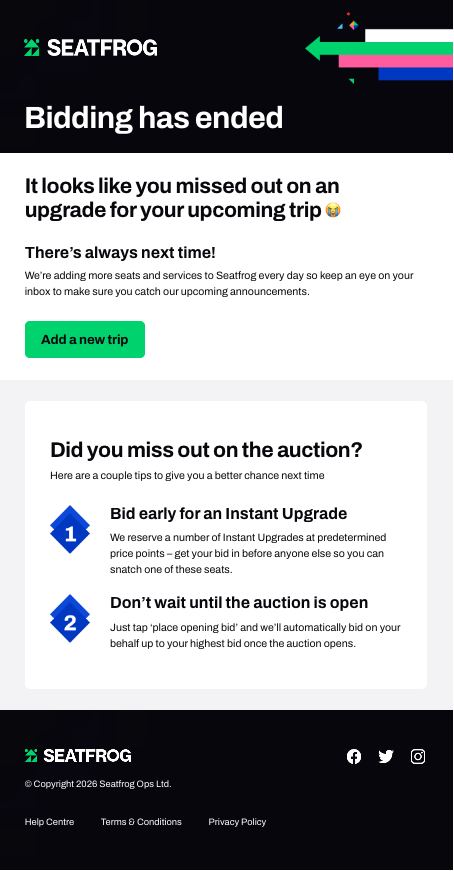 The full record ↗ The full record ↗PUSH reaches them outside the app | CHANGE A rewrite of the push that already sends at the close, with the sell stripped out. | COPY ONLY Title and body. |
▸ The job, the copy and where it livesWhere the copy lives NATIVEEngineering ships the wording in a release. It stays native. The job to be done Bring the customer who was away from the app to the end-of-auction screen.It states what happened and sells nothing. Copy direction, not final words Your auction has ended; here is how it closed. |
| 4 | Sorry messages PHASE 1 Its send is on the CRM brief. ▸ Today, live: the creative this reworksToday, live 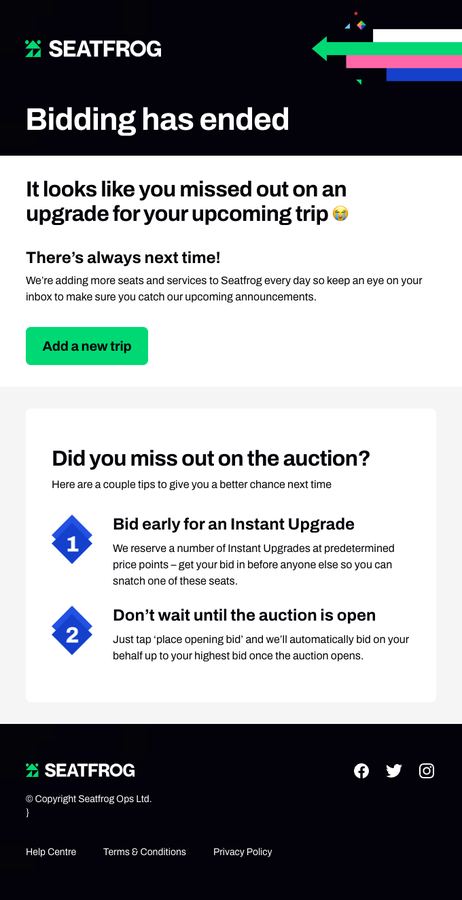 The loss email it reworks; the closed-early variant folds in. The full record ↗PUSH, THEN EMAIL reaches them outside the app | PART NEW Only the early-close cause has a send today. Our technical fault and operator pulled the seats have nothing at all. | COPY ONLY Push and email copy for three causes. |
▸ The job, the copy and where it livesWhere the copy lives BRAZECRM ships it, no release. The job to be done When the close was not the customer's doing, say what happened, say where their money stands, and give one way forward.Never “you lost” on a close that never ran, and never “it never completed” on one that did. The three share one template, so they have to work as variants of a single design. Copy direction, not final words
|
| 6 | Day-one how-it-works email PHASE 1 Its send is on the CRM brief. ▸ Today, live: the creative this reworksToday, live 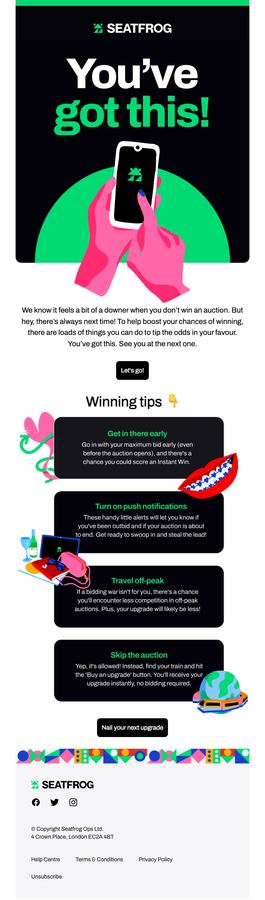 The full record ↗ The full record ↗EMAIL reaches them outside the app | REBUILD A live email exists, and the ruling is to build it fresh rather than rework it. | COPY AND DESIGN A complete email, both data states, plus the two-question help survey as a tap module. The education slot never repeats a lesson: a repeat loser gets acknowledgement and changed advice. |
▸ The job, the copy and where it livesWhere the copy lives BRAZECRM ships it, no release. The job to be done Teach the loser how to win next time, and tell them how close they were. Day one owns the mechanic: how bidding works, and what happened to you.Education, never recovery. No offer language in the standard versions; the near-miss credit appears only inside its test cell and is never advertised in advance. Copy direction, not final words
|
| 7 | Day-three come-back email PHASE 1 Its send is on the CRM brief. New: nothing sends today, so there is no live creative. EMAIL reaches them outside the app | NEW Nothing sends at day three today. Every post-loss send fires at the close. | COPY AND DESIGN A complete email, both data states, plus the fallback layout and a push variant. |
▸ The job, the copy and where it livesWhere the copy lives BRAZECRM ships it, no release. The job to be done Give one good reason to look again, to the people who have not already come back on their own. Day three owns the way forward: when the next chance is, and what a winning number looks like on that route.
Copy direction, not final words There is another auction on your route on {{next_auction_day}}, and recent upgrades on it went for {{price_low}} to {{price_high}}. |
| 11 | Outbid email PHASE 1 Its send is on the CRM brief. ▸ Today, live: the creative this reworksToday, live 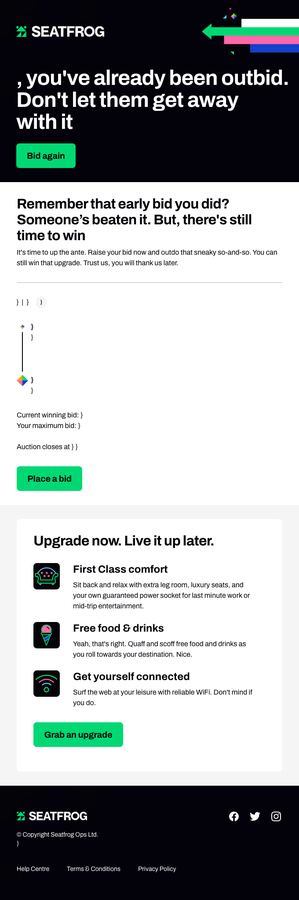 The full record ↗ The full record ↗EMAIL | CHANGE A template change on a live email, not a new send. | COPY AND DESIGN The class-named headline and benefit lines, on the live template. The fight-back line comes out. |
▸ The job, the copy and where it livesWhere the copy lives BRAZEBoth outbid variants are live Braze campaigns and ours to edit. The job to be done Tell them they are outbid, name the class, and make the way back one tap.Copy direction, not final words The class-named headline, benefit lines per class, and no price line ever showing a blank. |
| 12 | Close email, merged PHASE 1 Its send is on the CRM brief. ▸ Today, live: the creative this reworksToday, live The full record ↗EMAIL, TWO TEMPLATES | CHANGE Both close templates exist and both stay live; the rule chooses between them. | COPY AND DESIGN Two branch layouts on the existing templates, tips block out; the loss branch gains a See your next auction button; the buy-now branch renders only where the offer is confirmed open and an upgrade confirmed available for the party, and drops to the loss branch otherwise. |
▸ The job, the copy and where it livesWhere the copy lives BRAZEBoth close emails are live Braze campaigns. The job to be done One outcome message per close, never two contradicting each other.Copy direction, not final words One send at the close, two branches: buy-now where an upgrade is confirmed available and the offer still open, the loss branch where it is not. Tips block out of both. No separate buy-now email follows. |
This table is the production ask, one row per surface: two surfaces are new, one extends a live screen. Row 8 is one screen whose card carries all nine endings, 28 numbered versions in all; the writing brief per ending lives on the App experience page and the FigJam in-app brief. This row carries only what Design produces.
| # | The asset | New, or a change to something live | What we need from Design | Every version to write |
|---|---|---|---|---|
| 8 | Auction-close screen PHASE 2 An app build: the end-of-auction screen is a native surface. 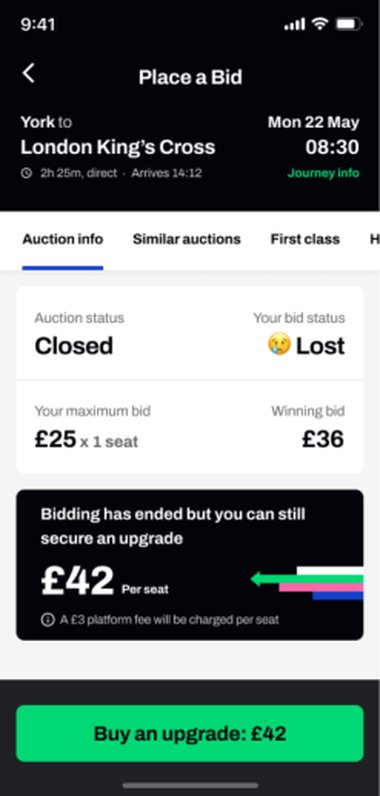 The app’s own header: Auction ended. Capture: Closed · Lost. IN THE APP inside the app | CHANGE The card slot already exists: today it carries the buy-now offer, the cross-sell or the practice-auction promo. The change is its copy and branching, not a new surface. | COPY ONLY
|
▸ The job, the copy and where it livesWhere the copy lives NATIVE→BRAZEThe card is native and always renders; its words move to the Braze copy layer in Phase 2, which is what makes the versions shippable without app releases. The job to be done Tell everyone who did not get the upgrade, honestly, how the auction closed, and give exactly one thing to do next. Sold out and a failed close are not losses and must not read as one.
Copy direction, not final words Here is how your auction closed, and the one thing you can do next. |
| 9 | Lock-screen bid status PHASE 2 Waits on the lock-screen status app build (iOS Live Activity). No capture held; the October design and drawn states: the App experience page. ▸ Today, live: the creative this reworksToday, live The full record ↗LOCK SCREEN outside the app, on the device | CHANGE A lock-screen stream already exists and Suze designed its states last October. This extends it rather than starting it. | COPY ONLY State copy, once the audit settles how many states there are. |
▸ The job, the copy and where it livesWhere the copy lives NATIVEAn app build. Braze governs entry, holdout and caps, but the surface is ours. The job to be done Carry bid status passively, so status pushes can retire without bid volume falling.It states, it never sells. And the starting state must stand alone: the card can freeze at its first state if the update token never uploads, so the first frame has to be true and useful with no updates ever arriving. Copy direction, not final words Your live bid status, at a glance. |
| 10 | Knocked-out message: party bigger than the seats left PHASE 2 Waits on the knocked-out rework: a backend release that carries party size. No capture held; drawn representation on the App experience page. New: no screen exists today. IN THE APP (A BRAZE IN-APP MESSAGE) inside the app | NEW The pushes that name this exist, but there is no screen that guides the way out. | COPY ONLY Copy for the cause and the two ways forward. |
▸ The job, the copy and where it livesWhere the copy lives NATIVE→BRAZEThe push is native today and moves to Braze. The screen itself is a Braze in-app message. The job to be done Name the cause plainly and guide the trade-off, so a resolution action replaces a dead end.Never blame the customer, and never say increase your bid: a party-size knock-out cannot be fixed by bidding. Start from Suze’s existing Avanti West Coast screen rather than from scratch. Copy direction, not final words Fewer upgrades are left than your party size, and here are your two ways forward. Where both classes run on the service, one suggestion line may note the party can sit across classes: a scenario, never a button. |
If it is not in these two tables, it is not in this round.
Versions fork on how new the bidder is, on what happened, or on whether they were winning. Travel personas decide who gets sent what, never what the words say. Every asset ships in two data states, personalised and a designed fallback, never a broken merge field, and any figure that cannot be substantiated drops out rather than softening. Where a row changes something live, today's version sits greyed beneath the proposal on the Live experience walkthrough, in the customer's own sequence.